Articles — Page 2
Below is a collection of assorted writings, a lot of them are from my old blog, "Absolutely No Machete Juggling." Most of the posts are about technology and programming, but odds are you landed here because I once wrote a very long post about Star Wars and it blew up like the second Death Star.
Star Wars Machete Order: Update and FAQ
Wow, this Machete Order thing got big! After the post first “went viral” and got mentioned on Wired.com, I started getting around 2,000 visitors to it per day, which I thought was a lot. But then in the months before Star Wars Episode VII: The Force Awakens was released, it blew up like Alderaan, peaking at 50,000 visitors DAILY. This year, over 1.5 million unique users visited the page. It’s been nuts.
Top 10 Career-Changing Programming Books
When I graduated with a Computer Science degree ten years ago, I was excited to dive into the world of professional programming. I had done well in school, and I thought I was completely ready to be employed doing my dream job: writing code. What I discovered in my very first interview, however, was that I was massively underprepared to be an actual professional programmer. I knew all about data structures and algorithms, but nothing about how actual professional, “enterprise” software was written. I was lucky to find a job at a place willing to take a chance on me, and proceeded to learn as much as I could as quickly as I could to make up for my deficiencies. This involved reading a LOT of books.

Getting "Real Work" Done
Of all the annoying things in this industry, there’s one occurence I see so often that it dwarfs all others, at least in frequency. I see this happen so often that I’ve been unable to post this despite having saved it to my Drafts nearly five years ago, because there’s never been a point in time where posting it wouldn’t make a co-worker think I was talking about them.

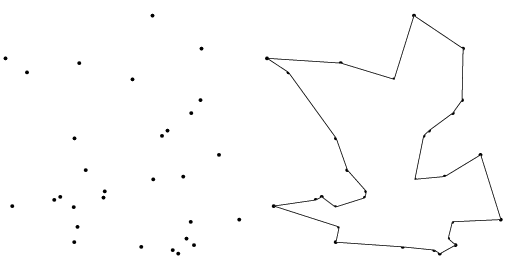
Traveling Salesperson: The Most Misunderstood Problem
Whenever people start talking about NP-Complete problems, or even NP problems, one of the first examples they reach for is the classic Traveling Salesperson Problem. TSP makes sense because it intuitively can’t be solved quickly due to how difficult the problem sounds, so it’s reasonable for people to use it in discussions about P versus NP.
Computer Science and Telescopes
Whenever there is a discussion about what Computer Science is and what it is not, it is a near-certainty that a particular quote will soon be used.

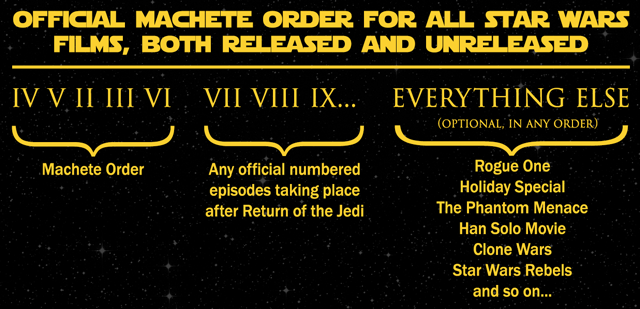
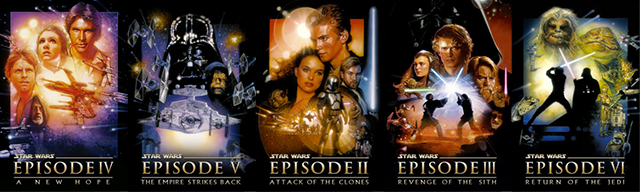
The Star Wars Saga: Introducing Machete Order
Watch them in this order: IV, V, II, III, VI. Skip I.
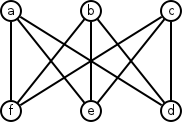
Why The Complete Bipartite Graph K3,3 Is Not Planar
The graphs \(K_5\) and \(K_{3,3}\) are two of the most important graphs within the subject of planarity in graph theory. Kuratowski’s theorem tells us that, if we can find a subgraph in any graph that is homeomorphic to \(K_5\) or \(K_{3,3}\), then the graph is not planar, meaning it’s not possible for the edges to be redrawn such that they are none overlapping.